01.01.2026
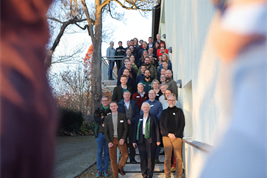
The FraxForFuture 2 (FraxRecovery) project got off to a successful start with a two-day kick-off meeting at the Northwest German Forest Research Institute (NW-FVA). Around 35 scientists from various research institutions and experts from forestry practice and businesses came together in Göttingen from December 15 to 16, 2025, to organize the joint project launch and set the course for the upcoming research phase. The kick-off meeting took place as a hybrid event with national and international participants. ZALF is involved with a working group.
Ash trees in Germany and throughout Central Europe are threatened by an invasive fungal pathogen. It is spreading particularly rapidly due to global warming. In the FraxRecovery project consortium, the ZALF MicGeo working group will use microorganisms that have already been assessed as protective and isolated from healthy ash trees in field trials. The aim is to develop methods for their stable application and effectiveness. The goal is the reliable application of these pre-tested protective microorganisms as a synthetic community (SynCom). The application of this novel SynCom can then curb the outbreak of the harmful fungus on a large scale or prevent its occurrence as a precautionary measure. Together with other measures being developed by the project partners, including the selection of particularly robust genetic ash variants, this should effectively halt ash dieback in Germany.
Kick-off in Göttingen
To kick off the event, Dr. Ralf-Volker Nagel, Director of the NW-FVA, and Gunnar Hirthe from the Agency for Renewable Resources (FNR) welcomed the participants and emphasized the importance of the project for the future of ash trees in Germany. The meeting was moderated by Dr. Gitta Langer (NW-FVA), spokesperson for the overall project.
The first day was devoted to practical insights: participants could choose between an excursion to an ash tree site and a visit to the NW-FVA's in vitro laboratory. Both program items offered an in-depth look at current research approaches to the regeneration and conservation of ash trees.
This was followed by a presentation of the newly established international scientific advisory board, which will support the project in technical and strategic matters. The board consists of the following individuals:
- Prof. Dr. Martin Gossner, Group Leader Forest Health and Biotic Interactions – Forest Entomology, Swiss Federal Institute for Forest, Snow and Landscape Research (WSL), Switzerland;
- DI Dr. Heino Konrad, Head of the Ecological Genetics Department at the Institute for Forest Biodiversity & Nature Conservation at the Federal Research Centre for Forestry (BFW) in Austria;
- Prof. Dr. Lene Rostgaard Nielsen, Department of Geosciences and Natural Resource Management, Forest and Landscape Ecology at the University of Copenhagen, Denmark;
- Dr. Valentin Queloz, Group Leader, Forest Health and Biotic Interactions Unit – Forest Protection Switzerland, Swiss Federal Institute for Forest, Snow and Landscape Research (WSL), Switzerland;
- Prof. Dr. Rimvydas Vasaitis, Dept. of Forest Mycology & Pathology, Swedish University of Agricultural Sciences (SLU), Sweden.
A central element of the kick-off meeting was the presentation of the ten sub-projects of FraxRecovery. The project partners presented their research approaches. These ranged from molecular genetic accompanying studies to in vitro culture propagation, microbiome optimization, and surveys of damage and biodiversity in ash stands to silvicultural and practice-oriented issues. This was followed by a discussion with the international scientific advisory board, in which the planned work was classified according to technical criteria.
Background:
Ash dieback is caused by the invasive fungus Hymenoscyphus fraxineus, also known as false white stem cup fungus. Ash dieback has been spreading in Germany since 2002 and has led to a significant decline in the common ash population.
Building on the findings of the "FraxForFuture" project, which is funded from 2020 to 2024, "FraxForFuture 2 (FraxRecovery)" is dedicated to the long-term conservation of ash trees. Promising methods for reintroducing the common ash are to be further developed and implemented in a practical manner in this follow-up project. The NW-FVA is participating in the joint project with sub-project 1 "Reintroduction of tolerant ash trees into forest ecosystems."
Funding information:
The FraxForFuture 2 project is funded by the Federal Ministry of Food and Agriculture (BMLEH) through the Agency for Renewable Resources (FNR) as part of the "Sustainable Renewable Resources" funding program.
Further information:
https://www.nw-fva.de/wir/aktuelles/pm-projektstart-fraxforfuture-2