05.06.2026
Press Release
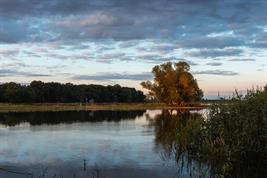
Researchers at the Leibniz Centre for Agricultural Landscape Research (ZALF) have investigated how water from surface water streams can be stored in the aquifer during wet periods.
The study was published in the Journal of Hydrology: Regional Studies. Using an area in the lower Spree catchment in Brandenburg as an example, the team utilized a computer model to demonstrate: Naturally occurring small basins in the landscape could absorb excess stream water, allowing it to seep slowly into the ground and subsequently stabilize groundwater and connected surface water bodies. In the calculations, the groundwater level rose locally by up to 2 metres. Water flow in connected streams could be increased by up to 15 percent.
Retaining water in the landscape
Brandenburg is one of Germany’s drier regions. Prolonged periods of drought and heavy rainfall make it more difficult to maintain a consistent water supply throughout the year. In the past, many landscapes in north-eastern Germany were artificially altered by ditches and drainage systems in such a way that water runs off quickly. Whilst this often helps with the use of fields, it can become a problem in dry years.
The researchers therefore investigated a method known as ‘managed aquifer recharge’. This involves temporarily available excess water from watercourses not being fully discharged during wet periods, but redirected into suitable basins. There it slowly seeps – much like rainwater in garden soil, yet planned and controlled.
“Our results show that small natural basins in the landscape can help retain water in the region for longer. This is particularly important as dry years become more frequent,” says Jan Stautzebach, lead author of the study at ZALF.
A computer model and 30 years of data
For the study, the team used a model that depicts both surface water and groundwater together. This is important because surface water streams and groundwater function like two interconnected parts of a system: if the groundwater level drops, a stream may receive less water. If it rises, the stream’s flow can be supported during dry periods.
The researchers examined an area of around 4.5 square kilometres in the catchment of the Demnitzer Mühlenfließ. The area comprises woodland, arable land and grassland. For the calculations, the team used weather and landscape data for the period 1991 to 2020. Various scenarios were used to examine how much water from the stream could be applied to nearby depressions suitable for infiltration, and how the soil, groundwater and stream would respond.
What is new about the study is that it did not merely calculate whether water infiltrates the ground. The team also investigated how this water subsequently affects connected streams. Their findings showed that the additional water moves slowly through the soil and aquifer and can have an impact over distances of several hundred metres. In the calculations, the influence on the groundwater level extended over more than 900 metres.
Hopes and concerns
The results show that the method can be particularly useful when implemented on a decentralized basis: in other words, not with large dams or powerful pumps, but with many smaller sites where water can seep into the underground. The researchers note that large-scale installations with high energy requirements would likely be unsuitable for this region, as there is probably not enough surplus water available during prolonged dry spells.
At the same time, the study makes it clear that the method must be carefully planned. If too much water is introduced, lower-lying areas may be flooded. This may be desirable in moors or wetlands but can cause problems near buildings or sensitive land areas. Plants can also be damaged if their roots remain in wet soil for too long.
The results are based on model calculations. They therefore show what would be possible under the chosen assumptions. For practical application, specific sites would need to be assessed on site: How well does the water infiltrate? Which areas might be affected? What pipes or ditches would be required? Who would operate and pay for the systems? The article does not yet specify any concrete costs.
With this new knowledge, authorities, water boards and land users could in future better assess where water can be retained in the landscape. A next step would be to investigate such sites in more detail and plan small-scale field trials. This would also involve assessing how much water can be abstracted from a stream without harming animals, plants or other uses.
Further Information:
DOI link to the original publication:
https://doi.org/10.1016/j.ejrh.2026.103533
Note on the text:
This is a summary of the original text generated using artificial intelligence: Stautzebach, J., Steidl, J., Merz, C. (2026):
Quantifying the effect of managed aquifer recharge on the hydrologic resilience of coupled surface-groundwater systems in northeast Germany. Journal of Hydrology: Regional Studies 66, 103533. https://doi.org/10.1016/j.ejrh.2026.103533, veröffentlicht Open Access / veröffentlicht unter der Lizenz CC BY 4.0
https://creativecommons.org/licenses/by/4.0/.
The text has been carefully reviewed and revised in accordance with the
AI guidelines at ZALF.
Funding information
This work was carried out as part of the SpreeWasser:N project and funded by the Federal Ministry of Education and Research (BMBF) under grant number 02WEE1633B.
Project partners
- Leibniz Centre for Agricultural Landscape Research (ZALF), Müncheberg
 Press Release as PDF