02.07.2026
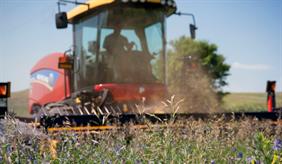
The significance of high-quality forage from the farm itself in reducing concentrate use
The timing of the alfalfa harvest has been identified as a key factor in determining the level of concentrated feed purchased by dairy farms. This correlation has been shown by by a recent study conducted by the Leibniz Center for Agricultural Landscape Research (ZALF), published in the journal Agricultural Systems. The present study utilised the FarmDyn optimisation model to investigate the impact of varying harvest times on forage quality, concentrate requirements and farm profit on a typical dairy farm in Brandenburg.
The utilisation of concentrates, such as soybean meal or rapeseed meal, can incur substantial costs and render agricultural enterprises susceptible to fluctuations in market prices. Concurrently, a supply deficit for protein-rich feed persists in Germany. Alfalfa could help to reduce this dependency . This legume species has been observed to thrive in the sandy soils of Brandenburg, a region characterised by its ability to fix nitrogen from the atmosphere. The species' extensive root system has been shown to facilitate resilience against drought, a trait that is particularly notable given the region's arid climate.
The study draws parallels between three management strategies for a conventional Brandenburg dairy farm with 172 dairy cows and 222 hectares of arable land. The three strategies are: a farm without alfalfa, a farm with standard alfalfa cultivation involving cutting at flowering, and a farm with high-quality alfalfa cultivation involving early cutting at a height of 50 cm.
High-quality alfalfa replaces expensive concentrated feed
The implementation of high-quality alfalfa resulted in a 24% increase in farm profit and a 56% reduction in the cost of purchased concentrate feed. Conversely, harvesting exclusively during the flowering phase led to a mere 4% increase in profit. The reason: Early-harvested alfalfa has been found to contain elevated levels of protein and energy, thus permitting its incorporation into concentrate feed rations at a higher proportion. „The findings of the present study demonstrate that the quality of alfalfa is of greater importance than the quantity harvested. The strategic timing of harvesting enables farmers to replace substantial quantities of concentrate while concurrently enhancing the farm's economic viability," asserts agricultural economist Anatol Thös (MSc) from the Leibniz Center for Agricultural Landscape Research (ZALF).
More effort—but also more benefits
Nevertheless, it should be noted that early harvesting necessitates a greater investment of effort. The implementation of four harvests between May and August resulted in an average augmentation of 44 % in the labour requirement during the summer months, as indicated by the model. However, the economic advantages evidently surpassed the associated expenditures.
A detailed investigation encompassing 1,000 model runs has been undertaken to ascertain the factors that exert the greatest influence on concentrate costs. The analysis revealed that alfalfa quality is the primary contributing factor. A decline in quality, attributable to factors such as delayed harvesting or drought stress, can rapidly erode the economic benefits. It is therefore vital that effective harvest management strategies are in place.
The researchers also identified additional benefits: namely, that alfalfa improves soil structure, promotes biodiversity, and can reduce the need for mineral nitrogen fertiliser. In future research, the potential for alternative uses of alfalfa cuttings of lower forage quality, such as in biogas plants, will be explored.
Further information:
Note on the text:
This is a summary of the original text generated using artificial intelligence:
Thös, A., Schuler, J., Kokemohr, L., Zander, P., Gutser, K., Uthes, S., Hosseini-Yekani, S.-A., Aurbacher, J. (2026): Harvest timing as a key lever for improvement of alfalfa-based feeding systems: A bio-economic analysis for a Brandenburg dairy farm. Agricultural Systems 237, 104774.
DOI: https://doi.org/10.1016/j.agsy.2026.104774
Published Open Access.
The text was carefully reviewed and revised in accordance with ZALF’s AI guidelines.
Funding Information
The study was conducted as part of the MEFAP collaborative project and was funded by the Federal Ministry of Education and Research (BMBF) under grant number 03WIR3021D.
Project partners:
- Leibniz Centre for Agricultural Landscape Research (ZALF) e. V.
- Ruralis – Institute for Rural and Regional Research, Norwegen
- Justus Liebig University Giessen