05.06.2026
Press Release
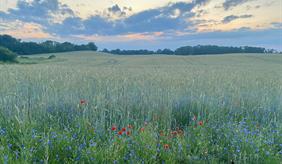
Many young adults are familiar with common species such as dandelions or sparrows. In contrast, plants and birds typical of fields, meadows, and other agricultural habitats are significantly less well known. This is shown by a new study from the Leibniz Centre for Agricultural Landscape Research (ZALF) published in the Journal of Ethnobiology and Ethnomedicine. For the study, the research team surveyed 463 adults of various age groups in an agricultural region of Germany. The results suggest that knowledge of typical agricultural landscape species is declining, particularly among younger generations.
For the study, participants were asked to name all wild plants and bird species they recognized from their surroundings. Unlike frequently used species identification tests employing photos, the research team thus investigated which species are actually spontaneously embedded in people’s knowledge.
In total, the respondents named 165 different plants as well as 116 bird species and bird groups. However, many of these names referred to commonly known species. Plants and birds typical of the agricultural landscape were named significantly less frequently. On average, participants could name only two characteristic plant species and three characteristic bird species, although 62 plant species and 25 bird species typical of the agricultural landscape occur in the study region. The vast majority of these species were unknown to the respondents or were named by only a very few people.
The most well-known plants included Dandelion, Common poppy, Cornflower, Common daisy, and Stinging nettle. Among birds, sparrows, crows, tits, Blackbird, and White stork were mentioned most frequently. In contrast, many other species that regularly occur in agricultural landscapes hardly played arole in the respondents’ knowledge.
“Our results show that many people are familiar with only a small fraction of the species that shape their landscape. Plants and birds that are particularly characteristic of the agricultural landscape are also particularly culturally significant. They are increasingly being overlooked, which points to an ever-more-disconnected relationship between our culture and our landscapes,” says
Dr. Maria Kernecker, a researcher at the Leibniz Centre for Agricultural Landscape Research (ZALF) and co-author of the study.
Clear differences between younger and older generations
The analysis shows a clear correlation between age and species knowledge. As age increased, the number of plant and bird species mentioned rose significantly. The differences were particularly pronounced between the youngest adults and the middle-aged groups.
Typical species of the agricultural landscape, such as Cornflower, Chamomile, Yarrow, Starling, or Skylark, were mentioned significantly more often by people over 45. Younger adults, on the other hand, more frequently named very common or widespread species such as Dandelion, Common Daisy, or Stinging nettle, as well as non-specific groups such as birds of prey, pigeons, or crows.
The researchers see this as evidence of a gradual loss of knowledge about the biological diversity of one’s own environment. Previous studies show that species knowledge can be closely linked to an interest in nature and a willingness to engage in nature conservation.
Species knowledge as the foundation for biodiversity conservation
The study makes it clear that while many species still occur in the landscape, they are hardly part of the public’s collective knowledge anymore. Plant and bird species typical of species-rich fields and meadows are particularly affected. They help experts assess the condition of habitats and highlight changes in biodiversity.
What is new about this study is that it did not test the ability to identify individual species, but rather investigated which plants and animals are actually part of people’s everyday knowledge. This reveals which species are present in a region’s cultural memory and which are increasingly falling into oblivion.
At the same time, the study design has limitations. The research was conducted in two towns and their surrounding areas in northwestern Saxony. The results therefore do not provide representative findings for all of Germany. Furthermore, the method primarily captures spontaneously available knowledge rather than a person’s entire species knowledge. The authors therefore recommend further studies using complementary methods.
The researchers see potential in environmental education programs that reconnect people more closely with their surroundings. These include outdoor education, nature observation, or direct engagement with plants and animals. Such programs could help strengthen knowledge of biodiversity and promote an understanding of the importance of functioning ecosystems.
“Those who know the species in their environment can more easily perceive changes in nature and better understand their significance for functioning ecosystems. Species knowledge is therefore more than mere factual knowledge—it is an important foundation for the conservation of biological diversity,” says
Dr. Tobias Naaf, co-author of the study from ZALF.
 Pressemitteilung im PDF-Format
Further information:
Note on the text:
This is a summary of the original text generated with the help of artificial intelligence (Mistral-large-3):
Naaf, T. & Kernecker, M. (2026). Young adults in eastern Germany know dandelion and sparrows but few farmland species. Journal of Ethnobiology and Ethnomedicine, 22, 51. https://doi.org/10.1186/s13002-026-00908-2. Published Open Access under the CC BY 4.0 license: https://creativecommons.org/licenses/by/4.0/.
The text was carefully reviewed and revised in accordance with
ZALF’s AI guidelines.
The study was conducted as part of the ECO2SCAPE project within the Research Initiative for Biodiversity Conservation (FEdA). Funding was provided by the Federal Ministry of Research, Technology, and Space (BMFTR), grant number ZALF: 03LW0082.