02.07.2026
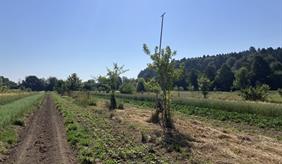
From June 22 to 26, the European Agroforestry Conference “EURAF26” took place in Neuchâtel, Switzerland, and ZALF was represented by two presentations from the doctoral students Alma Thiesmeier and Julia Fritzsche.
The conference brought together over 400 people from academia, politics, and the agricultural and forestry sectors to network, share knowledge about agroforestry across national borders, and translate scientific findings into practical knowledge. This year’s focus was on food security, practical agroforestry, the compatibility of agriculture and nature, and the concrete design of agroforestry systems.
Alma Thiesmeier presented the results of a survey on the preferences of German farmers regarding the framework conditions that can lead to the practical implementation of agroforestry systems. The results show that the economic performance of these systems remains a decisive factor. However, additional public payments, particularly annual payments for management costs and subsidies for establishment costs, combined with additional ecological benefits can help convince farmers to adopt agroforestry. However, further analyses have also shown that for many farmers in Germany, agroforestry remains primarily an environmental measure and is viewed less as an economic opportunity. This makes it clear that the focus in the future must be on the value added by agroforestry to convince farmers of the long-term benefits of these systems.
Julia Fritzsche presented her latest findings from the Agroecology4Climate project during the session “Agroforestry as a Driver of Agroecology.” Her interviews with over 50 farmers from Brandenburg revealed that various agroforestry practices can make an important contribution to agroecology and resilience. Farmers described erosion control, soil health, and animal welfare as positive effects of their agroforestry plantings.
The highlight of the conference was the field trips on Wednesday to a variety of nearby agroforestry farms. These agroforestry systems, many of which are still very young, are intended to promote product diversification and provide shade and forage for animals, among other benefits. Other field trips included visits to vitiforest systems, where viticulture is combined with tree cultivation.