16.07.2026
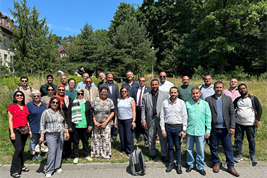
At the end of June and beginning of July, ZALF welcomed a delegation of around 20 representatives from the Egyptian Ministry of Agriculture and Land Reclamation, the Deutsche Gesellschaft für Internationale Zusammenarbeit (GIZ), the Agricultural Research Centers, Egyptian universities, civil society organizations, and agricultural practitioners. The visit took place within the framework of the Agriculture Innovation Project II (AIP II), commissioned by the German Federal Ministry for Economic Cooperation and Development and implemented by GIZ in Egypt.
The delegation visited ZALF as part of the new project DESIGN-LL Egypt – Designing, Governing, and Developing a Scaling-Up Roadmap for Living Labs for Climate-Resilient Smallholder Farmers in Upper Egypt. Through this collaboration, ZALF provides the scientific leadership for the design, governance, monitoring, evaluation, and learning of Living Labs that will support climate-resilient agricultural innovation across four governorates in Upper Egypt, while GIZ and the Agricultural Research Center coordinate the implementation of Living Lab activities with local partners.
Strengthening international collaboration
The study visit aimed to strengthen scientific collaboration between ZALF and Egyptian partners while providing first-hand insights into ZALF's research infrastructure, Living Lab methodology, and innovative approaches to sustainable agricultural systems. It also marked the official launch of a long-term scientific partnership that will support the establishment of 24 Living Labs and the development of climate-smart agricultural innovations in Egypt.
Throughout the week, participants exchanged experiences on climate-smart agriculture, participatory innovation, governance, transformative learning, digitalization, monitoring and evaluation, and scaling pathways for agricultural innovations. The discussions highlighted the importance of bringing together researchers, farmers, policymakers, advisory services, civil society organizations, and private-sector actors to co-design practical solutions that strengthen the resilience and sustainability of agricultural systems.
Exploring ZALF's research and innovation landscape
The program combined scientific presentations, workshops, laboratory visits, field demonstrations, and networking activities, giving participants a comprehensive overview of ZALF's interdisciplinary research and innovation ecosystem.
The visit began with presentations by the Development-oriented International Agricultural Research working group and ZALF researchers, followed by an introduction to the institute's research infrastructure. During a guided campus tour led by Moritz Reckling, the delegation explored ZALF's experimental facilities, including agri-photovoltaic systems and ongoing landscape experiments. Laboratory visits with Jörg Schaller provided insights into research on improving soil water-holding capacity and innovative approaches to increasing agricultural resilience under changing climatic conditions.
A field excursion to the PatchCROP experimental platform in Tempelberg, guided by Marcus Schumacher, showcased robotic field experimentation, precision agriculture, diversified cropping systems, and innovative methods for climate-resilient farming under field conditions. Participants also attended the ZALF Sommerfest, creating additional opportunities for informal exchange and networking with researchers from across the institute.
A dedicated Living Lab Workshop brought together researchers from different disciplines to discuss the conceptual foundations, governance, implementation, and scaling of Living Labs for climate-resilient agriculture. The workshop featured contributions from Fabian Brauns, Franziska Ollendorf, Fatima Lehnhardt, Nina Hagemann, Michael Spies, Carsten Paul, and Appollinaire William, who shared experiences from Germany, the Mediterranean region, Rwanda, and other international case studies providing valuable international perspectives and opportunities for cross-country learning. The workshop concluded with an interactive discussion on transferring these experiences to the Egyptian context.
The study tour concluded with visits to Brandenburg farming systems with Fabian Brauns, including innovative livestock and mixed farming enterprises, where participants discussed sustainable land management, climate adaptation strategies, and practical approaches for translating research into agricultural practice.
Looking ahead
The visit laid the foundation for a long-term partnership between ZALF, GIZ, and Egyptian research institutions and universities. Over the next three years, the collaboration will establish 24 Living Labs across Upper Egypt, support PhD researchers jointly supervised by ZALF and Egyptian partners, and generate scientific evidence on governance, innovation adoption, transformative learning, value chain development, and scaling pathways for climate-resilient agriculture. By combining scientific excellence, transdisciplinary research, and participatory innovation, the project aims to strengthen the resilience of smallholder farming systems while contributing to sustainable agricultural transformation in Egypt. The collaboration further reinforces ZALF's role as an international leader in Living Lab research and the co-development of solutions for resilient agricultural landscapes.