August 10, 2026
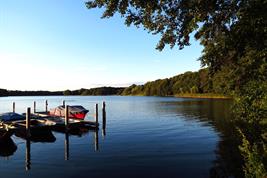
Climate change is putting increasing pressure on groundwater-fed lakes in Brandenburg. An international research group, including the Leibniz Center for Agricultural Landscape Research (ZALF), used Groß Glienicker See – located on the border between Berlin and Brandenburg – as a case study to investigate how water levels and groundwater recharge might develop by the year 2100. The results were published in the journal Water Resources Research. The study combines a full integrate hydrologic model, driven by 43 different climate projections, with machine-learning methods.
The Lake Groß Glienicke covers an area of 0.59 km², and reaches a maximum depth of 10 m. Since 2014, the water level of Lake Groß Glienicke has dropped by more than 1.28 meters – equivalent to an average decline of over 10 centimeters per year.
The model results show that only a small portion of precipitation, about 5%, contributes to groundwater recharge in the catchment of the lake. Long dry spells reduce soil moisture and can suppress groundwater recharge for several years, even after precipitation increases again.
If the soil remains dry for an extended period, incoming precipitation may first replenish soil moisture deficits rather than contribute to groundwater recharge. These delays recharge and reduce groundwater contributions to lake storage, making groundwater-fed lakes particularly vulnerable to prolonged droughts.
Three possible futures for the lake
To predict how the lake’s water level will change by the year 2100, the researchers used a coupled modeling framework driven by 43 EURO-CORDEX climate projections and analyze representative wet, moderate, dry climate conditions. The hydrologic model was calibrated and validated using observed lake and groundwater levels and independent isotope-based estimates of key water balance components over the period 2008–2023. results differ significantly:
In the wet scenario, the lake’s water level remains relatively stable throughout the century, whereas the moderate scenario shows a gradual decline in lake levels. Under the dry scenario, however, groundwater recharge decreases strongly after 2030, leading to a projected lake-level drop of more than 2 m by 2100.
The differences between the dry and wet projections exceed 4 meters in lake level by the end of the century, highlighting the large uncertainty associated with future climate conditions.
Additional uncertainty arises from evaporation estimates, particularly those related to incoming global radiation, while changes in precipitation dynamics and prolonged droughts prove to be important external factors.
Notably measured lake and groundwater levels since 2015 are already following the lower range of the simulated trajectories, indicating that recent conditions are consistent with the drier end of the projected future range.
A novel combination of models and artificial intelligence
What distinguishes this study is the integration of several advanced modeling approaches. The researchers used a numerical model called HydroGeoSphere, capable of representing surface water, unsaturated zone, and groundwater flow. Many earlier studies treated this hydrological process separately. In addition, machine learning methods were applied to estimate future groundwater withdrawals and the Havel River levels, which were used as boundary conditions for the numerical model. A surrogate meta-model then enabled the efficient generation of 1,000 simulations to characterize uncertainty and explore a wide range of possible future lake responses.
What the results mean for the future
The research findings have important implications for water management in Berlin and Brandenburg, where groundwater resources support both human water use and groundwater-dependent ecosystems. More than 6 million people in the region rely heavily on groundwater for their drinking water supplying significantly more than the European average. A long-term reduction in groundwater recharge could increase pressure on water resources and exacerbate conflicts among different water demands, including drinking water supply, agriculture, nature conservation, and recreational uses.
The researchers point out that their projections regarding groundwater withdrawal are based on population growth and do not take into account for possible changes in water-management strategies, conservation measures, and technical developments.
Therefore, proactive adaptation measures could potentially influence future system behavior, although their effectiveness would require further assessment.
At the same time, the results show that even under moderate climate scenarios, seasonal patterns are shifting: In the future, the highest water levels will tend to occur in June rather than in April as they do now, and low-water periods in the fall will last longer. This potentially affects groundwater dependent ecosystems and lake habitats.
The study highlights the need for further research to understand how various adaptation measures would affect the overall system. It would be particularly important to develop concrete scenarios for water use and conservation measures and to test their effects.
Project partners:
- Freie Universität Berlin, Department of Geology
- Humboldt University of Berlin, Integrative Research Institute for Transformations of Human Environmental Systems (IRI THESys) and Department of Geography
- Technical University of Berlin, Department of Water Resources Management and Hydrosystem Modeling
- University of Twente, Netherlands, Faculty of Geo-Information and Earth Observation
- German University of Technology in Oman (GUtech), Department of Applied Geosciences
- Leibniz Center for Agricultural Landscape Research (ZALF), Working group Lowland Hydrology and Water Management
Funding note:
This study was funded by the Einstein Research Unit “Climate and Water in Transition” of the Einstein Foundation Berlin and the Berlin University Alliance (ERU-2020-609).