12.08.2026
Müncheberg, August 12, 2026 – Seeds from cultivated plants carry not only the genetic material of the next generation, but also seed-associated bacteria, some of which can be passed on by the parent plant. A recent review article in the journal “Current Research in Microbial Sciences” summarizes the current state of research on the transmission and function of these seed bacteria. The Leibniz Center for Agricultural Landscape Research (ZALF) led the study. The review highlights that these microorganisms can influence germination, early growth, and the seedlings’ resilience to stressors such as drought.
From Flower to Seedling: How Bacteria Enter the Seed
Seeds provide a unique habitat for microorganisms. Bacteria colonize both the surface and the interior of the seed. Some of these bacteria are transferred vertically from the parent plant to the offspring. Studies show, however, that only a limited portion of the bacterial communities take this route. In rice, for example, certain bacterial genera such as
Pantoea and
Xanthomonas were detected across two generations, with high genetic similarity between parent and offspring seeds.
However, a large portion of microbial diversity is acquired horizontally from the environment (e.g., from soil, airborne particles, or via insects). After sowing, the seed-borne bacteria mix with those from the soil. In this process, soil-derived bacteria often dominate the seedling microbial community assembly, and only a small fraction of the seed-borne bacteria remain detectable.
Breeding and Environment Shape the Seed Microbiome
The diversity and composition of seed bacteria are influenced by several factors. The genotype of the host plant plays a role: in winter rapeseed, the bacterial community differed between varieties. Breeding history also has an impact. The transition from wild emmer to domesticated bread wheat led to a reduction in the rich diversity of bacteria in the seed.
In maize, seeds from traditional landraces harbored a significantly higher abundance of endophytic microbes and greater taxonomic diversity than modern hybrid varieties. Functional tests further indicated that endophytes from landraces differed in antagonistic properties against soil bacteria, including Burkholderia species detected in landrace seeds.
The environmental conditions to which the parent plant is exposed during flowering and seed maturation also shape the seed microbiome. In wheat, reduced precipitation initially led to yield losses in a drought-sensitive variety but simultaneously favored the selection of specific bacterial endophyte communities in the seed. In subsequent generations, offspring whose seed microbiota resembled these drought-associated communities showed yield stability under renewed water stress.
From Research to Application: Opportunities and Challenges
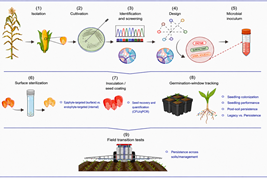
These findings open up possibilities for targeted microbiome engineering in agriculture. By inoculating seeds with defined bacterial communities (so-called SynComs or consortia), beneficial traits such as improved germination, nutrient mobilization, or pathogen defense could be promoted.
Dr. Hamed Azarbad of ZALF, the coordinator of the study, explains: “The challenge lies in ensuring the stable expression of functions carried by seed-transmitted bacteria. Effects observed in the laboratory during germination often diminish after contact with the soil, when the seed- and soil-derived communities mix. To ensure a successful application, we need to understand which bacteria survive the transition from seed to seedling and which factors enable their persistence in the field.”
Societal Relevance and Research Needs
In light of climate change, understanding the seed microbiome is becoming increasingly important. Heat and drought can impair seed germination if seedlings have only limited adaptive capacity. Seed-associated microorganisms are already present during germination and could help improve early plant performance under increasing environmental variability.
However, gaps in knowledge remain. Most studies document taxonomic overlaps across life cycles rather than tracking the persistence of specific bacterial strains across generations. Furthermore, the mother plant’s environmental conditions can trigger heritable changes in the host, including epigenetic modifications such as DNA methylation. These can influence offspring phenotypes independently of the microbiome. Future studies should therefore distinguish between microbial and epigenetic contributions to understand how microbial and plant “memory” shape plant performance across generations.
Translating laboratory findings into field practice remains another challenge. Previous work suggests that SynCom members may become less common later in plant development, yet still leave long-term effects on community composition and plant performance. It is important to consider persistence (the continued detectability of introduced strains) and legacy effects (downstream shifts that persist after introduced strains become rare or undetectable) as separate outcomes.
Funding Acknowledgment:
This work was funded by the German Research Foundation (DFG), project number: 523864000.
Project Partners:
- Marburg University, Department of Biology, Evolutionary Ecology of Plants, Marburg, Germany
- Leibniz Center for Agricultural Landscape Research (ZALF), Microbial Biogeochemistry, Müncheberg, Germany
- • Tarbiat Modares University, Department of Plant Pathology, Faculty of Agriculture, Tehran, Iran
Further information:
DOI link to the original publication:
https://doi.org/10.1016/j.crmicr.2026.100647
Note on the text:
This is a summary of the original text generated using artificial intelligence (Qwen 3.5): Azarbad, H., Alizadeh, M. (2026). Seed bacterial microbiota: transmission, community assembly, and prospects for engineering heritable functions in crops. Current Research in Microbial Sciences 11, 100647. DOI:
https://doi.org/10.1016/j.crmicr.2026.100647, published Open Access/licensed under CC BY 4.0
https://creativecommons.org/licenses/by/4.0/. The text was carefully reviewed and revised in accordance with ZALF’s AI guidelines.