21.08.2026
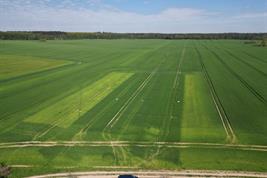
A research team from working group PB1 ECO at the Leibniz Centre for Agricultural Landscape Research (ZALF) has investigated how certain additives in nitrogen fertilizers can reduce the environmental impact of agriculture. The results were published in the journal Nutrient Cycling in Agroecosystems. A multi-year field trial in Brandenburg showed that specific inhibitors in fertilizer significantly reduced emissions of climate-damaging gases while simultaneously improving the plants’ uptake of the fertilizer.
Nitrogen fertilizer is essential for high crop yields. However, its use often results in emissions of nitrous oxide (N₂O) and ammonia (NH₃). Nitrous oxide is a particularly potent greenhouse gas and has nearly 300 times the climate impact of carbon dioxide. The researchers therefore tested so-called urease and nitrification inhibitors. These substances slow down chemical processes in the soil, allowing plants to absorb nitrogen for longer before it is lost as a gas.
Significantly less nitrous oxide and ammonia
The study was conducted under real-world conditions on a farm in the Uckermark region. Over a total of 817 days, the team studied the cultivation of corn, wheat, and barley on an area of approximately 6,000 square meters. Four variants were compared: without fertilization, with standard nitrogen fertilizer, and with fertilizer plus various inhibitors.
The results showed substantial reductions in gaseous nitrogen losses under specific crops and treatment combinations. In the most effective treatment and crop combinations, nitrous oxide emissions were reduced by up to 72% and ammonia emissions by up to 91% compared with conventional fertilization. In addition, the plants absorbed nitrogen more efficiently, resulting in greater plant biomass production and improved nitrogen-use efficiency. The combined use of urease and nitrification inhibitors improved the carbon net ecosystem balance. Across the entire crop rotation, the treatment with both inhibitors shifted the system from a net carbon source to a net carbon sink. This means that more carbon was stored in the soil than was released into the atmosphere.
Higher Yields with Similar Water Consumption
The researchers also observed slightly higher evapotranspiration, while water-use efficiency remained stable or improved because crops produced more biomass. These findings suggest that the additives may help maintain efficient water use even under increasing drought pressure, although this was not directly tested in the study.
To date, there have already been numerous studies worldwide on such inhibitors. However, many of these studies were conducted under laboratory conditions or in small experimental plots. The new study stands out because it was conducted on a farm under real-world conditions. At the same time, the authors point out that the study has limitations: For practical reasons, the experimental plots could not be arranged completely at random. Because the nitrification inhibitor was only available in combination with a urease inhibitor, the researchers could not fully separate the effects of the two additives.
Opportunities for more climate-friendly agriculture
The results could help reduce greenhouse gas emissions from agriculture in the future while also using fertilizers more efficiently. However, such additives come with additional costs. Previous studies show that economic viability can vary depending on weather, soil, and crop type. Therefore, the researchers see a need for further research, for example on long-term effects on soils, yields, and costs for agricultural operations.
Project partners:
- Leibniz Centre for Agricultural Landscape Research (ZALF)
- Humboldt University
- SKW Stickstoffwerke Piesteritz GmbH
Further information:
DOI link to the original publication: https://doi.org/10.1007/s10705-026-10472-6
Note on the text:
This is a summary of the original text generated using artificial intelligence (Mistral-large-3):
Monzon Diaz, O. R., Kramp, K., Zentgraf, I., Schmidt, M., Lück, M., Nikkel, A., Verch, G., Augustin, J., George, E., Holz, M., Dubbert, M. & Hoffmann, M. (2026): On-farm effects of urease and nitrification inhibitors on resource use, soil C and climate impact. Nutrient Cycling in Agroecosystems 132:26.
DOI: https://doi.org/10.1007/s10705-026-10472-6, published Open Access / published under the licence CC BY 4.0
https://creativecommons.org/licenses/by/4.0/.
The text has been carefully reviewed and revised in accordance with ZALF’s AI guidelines.
Funding Information:
Fachagentur Nachwachsende Rohstoffe e. V. (FNR) through the project WIN-N (2220NR082C).