16.07.2026
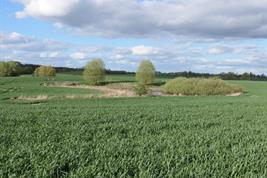
Small, often inconspicuous depressions in the landscape, known as “kettle holes”, can release significant amounts of methane, a gas harmful to the climate. But how much methane is actually produced depends on microbes and small-scale differences in the soil. A new study published in the journal Geoderma shows that the microorganisms that produce or break down methane are distributed very differently in these depressions. The Leibniz Center for Agricultural Landscape Research (ZALF) played a key role in the study.
Kettle holes (also known as potholes) are small, bowl-shaped depressions in the landscape that formed during the last ice age. They are often surrounded by cropland and are natural wetlands that fill with water from rain but are drying out more frequently and for longer periods due to climate change.
Methane is a strong greenhouse gas that is about 28 times more potent than carbon dioxide. It is produced naturally when specific microorganisms - known as methanogens - decompose organic material in oxygen-deficient soils. However, there are also microbes that break down methane: the methanotrophs, which require oxygen. Both groups live in kettle holes that sometimes dry out and sometimes flood. Soil conditions also vary from place to place, making it difficult to predict methane release.
The researchers studied three different kettle holes in Brandenburg. Their findings showed that the distribution of methane-producing and methane-consuming microorganisms depends heavily on soil structure (the so-called soil horizons). Even within a single kettle hole, there were pronounced differences: methane-producing microorganisms were found more abundant in the peat and varied depending on the vegetation composition of the kettle holes. Methane-consuming organisms exhibited different patterns across the kettle holes, depending on the soil horizons.
Why small differences have major consequences
The study makes it clear that the occurrence of methane-producing and methane-consuming organisms in kettle holes cannot be easily generalized, even if these kettle holes are similar in type and water level.
“These small depressions can be hotspots for methane. But their actual impact on the climate is difficult to predict because conditions in the soil vary so much,” explains Danica Kynast, first author of the study and a researcher at ZALF.
The researchers analyzed not only the abundance of microbes but also their diversity. Their findings revealed that the soil horizons have a major influence on the composition of microbial communities. For example, certain methane-producing microbes that can tolerate oxygen were found particularly in the upper soil layers.
What does this mean for climate protection?
Kettle holes are very common in some regions of the world and could affect regional methane budgets substantially. The study suggests that it is not enough to know only the size or type of a kettle hole to estimate its methane emissions. Rather, the soil structure and the microbes living there must be closely examined to better understand their role in the climate system.
The study’s findings represent an important step toward investigating the significance of kettle holes for the climate. However, further research is needed: How do microbial communities change over longer periods of time, for example due to changes in the water level of the kettle hole or differences in the management of surrounding farmland? These questions must be addressed in future studies.
Further information:
DOI link to the original publication:
https://doi.org/10.1016/j.geoderma.2026.117872
Note on the text:
This is a summary of the original text generated using artificial intelligence: Danica Kynast, Lisa Kastenholz, Alexandre Arrivabene, et al. (2026). Methanotrophs and methanogens are differently affected by small-scale heterogeneities in transiently flooded kettle holes. Geoderma, 471, 117872.
https://doi.org/10.1016/j.geoderma.2026.117872, published Open Access under the license CC BY 4.0, https://creativecommons.org/licenses/by/4.0/. The text was carefully reviewed and revised in accordance with the
AI guidelines at ZALF
Funding Acknowledgment
This work was funded by the German Research Foundation (DFG) as part of the
MeDKet project (grant number 465808595).
Project Partners
- Leibniz Center for Agricultural Landscape Research (ZALF) e. V., Müncheberg
- University of Bonn