24. Juni 2026
Researchers at the Leibniz Center for Agricultural Landscape Research (ZALF), in collaboration with international partners, have published a handbook that shows how to build your own environmental sensors inexpensively and using simple materials. The guide is aimed at researchers, students, and practitioners worldwide, especially in regions where expensive measuring devices are often unavailable.
The development of low-cost environmental sensors (SensorWeb) is an integral part of the AgroFlux® sensor platform, which aims to study the carbon, nitrogen, and water cycles in agriculture. The handbook contains detailed construction instructions and the necessary software for the environmental sensors. It has been published as a living document on the Zenodo platform. This means that regular updates are released in the form of new versions and are freely accessible to everyone.
Building Your Own Measurement Technology: Affordable Sensors for Everyone
How do you actually measure how much water a plant needs? Or how much climate-damaging greenhouse gases a field emits? Normally, this requires expensive equipment that is often only available in wealthy countries. The manual developed by the team led by ZALF researcher Dr. Mathias Hoffmann explains how to build your own sensors using simple components and a bit of DIY skill. These sensors measure, for example:
- Spectral plant indices: How healthy is my plant? How well is it developing?
- Evapotranspiration and greenhouse gases: How much CO₂ or methane does a field emit?
- Microclimate: How warm and humid is it directly above the ground?
The goal is to make science accessible to everyone—regardless of whether someone is conducting research in Germany, Ghana, or Bolivia. This allows local farms to collect data themselves and figure out how to manage their fields more sustainably.
The mobile lab: Lab-on-wheels
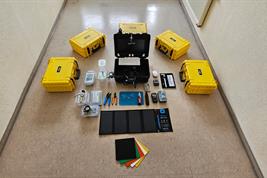
The building instructions are designed so that they can be followed even without expensive tools. Particularly interesting: The Lab-on-Wheels project—a solar-powered construction and programming station in a suitcase format—brings the necessary equipment directly to users. Whether in Syria, Benin, or Rwanda, anyone without their own workshop can borrow the mobile labs to build and program sensors.
Depending on the intended use and components, the low-cost sensors cost between 60 and 300 euros. This makes them a fraction of the cost of high-cost sensors, which can range from 3,000 to 10,000 euros depending on the model. Shipping the Lab-on-Wheels kits is currently being tested as part of an initial rollout. The first six kits will be sent to partner institutions in the summer of 2026. Recipients will replicate the sensors, test them, and provide feedback so that adjustments can be made if necessary.
Anyone interested in borrowing a kit or who has questions can contact Dr. Mathias Hoffmann directly: Mathias.Hoffmann@zalf.de.
From Research to Practice: Why the Project Is Important
Agriculture faces major challenges: Climate change is altering weather conditions, soil fertility is declining, and at the same time, more food must be produced for a growing global population. Finding solutions requires data—but that data is often hard to come by, especially in poorer regions.
This is where AgroFlux® comes in: The platform combines high-precision measuring devices with low-cost, DIY sensors (SensorWeb). With the help of these sensors, farms worldwide can determine how their soils and plants are performing—and how they can better protect them. The data helps, for example, to determine:
- How much water a plant actually needs and when—and when water can be conserved.
- How much greenhouse gas a field emits—and how to reduce it.
- How different farming methods affect the soil—and which ones are the most sustainable.
So far, five different DIY sensors have been developed, which are described in detail in the manual. The instructions are kept simple enough that even schools or local environmental groups can use them.
Initial research based on data from the sensors has already been completed in Benin. Other research teams in Uganda, Rwanda, and Syria plan to work with the sensors.
What’s next?
The handbook is constantly being expanded. The next version, for example, will include instructions for an affordable system for sampling air in measurement chambers.
Users are warmly invited to build on the existing drafts, share adaptations, and contribute new chapters. Simply send an email to the author (mathias.hoffmann@zalf.de) and submit an update.
Future versions will include additional low-cost DIY systems as well as their integration into the MonksHillLab Logger app, an application developed by the working group. Together, the group aims to develop this manual into a practical, constantly evolving resource for researchers, students, and practitioners.
The research group plans to host an online workshop or a Low-Cost Sensor Summer School. Here, interested participants can learn how to build and use the sensors themselves. Anyone interested in helping to shape this format can get in touch via the feedback link: https://docs.google.com/forms/d/e/1FAIpQLSd-lZMnjAK-ll1-eMoKwWdKpjrdHeFioPDRd5Fp-lMQW38EWg/viewform?usp=header
Project partners:
- University of Damaskus, Faculty of Agriculture, Department for Rural Engineering (Syrien)
- CSIR-Savanna Agricultural Research Institute (SARI) (Ghana)
- University of Abomey-Calavi, Laboratory of Hydraulic and Water Control (LHME), National Water Institute (Benin)
- Ministry of Water and Environment, Department of Wetlands (Uganda)
- University of Greifswald
- University of Rwanda - CAFF (Ruanda)
Note on the text:
This is a summary of the original text generated using artificial intelligence (Mistral-large-3): Hoffmann, M. (Ed.), Macagga, R., Asante, M., Sossa, G., Al-Hamwi, W., Dahlmann, A., Dubbert, M., Dubbert, D., Marschall, J., & Shay Kretzschmar, M. (Year). Build-It-Yourself: Low-Cost Systems for Field Ecophysiology. An Open Handbook for DIY Environmental Measurement Systems. Zenodo. https://doi.org/10.5281/zenodo.17943693, published under the CC BY 4.0 license https://creativecommons.org/licenses/by/4.0/. The text has been carefully reviewed and revised in accordance with the AI guidelines at ZALF.
Infomaterial und weiterführende Informationen: