25.02.2026
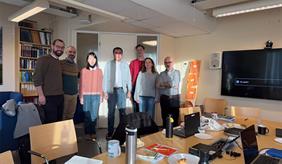
From 21-23 January 2026, the IMA members participated in an international Water Research Workshop, hosted by the System Dynamics Group at the University of Bergen (UiB)’s Department of Geography. The main aim of the workshop was to explore collaborative approaches to pressing water challenges in semi-arid regions.
Prof. Ahmad Hamidov (ZALF) presented research on the water-energy-food (WEF) nexus in semi-arid Central Asia, demonstrating how Sustainability Impact Assessment (SIA) protocols can be applied to complex transboundary water challenges. He also presented his RebUz research project, focusing on the rebound effects of irrigated agriculture in Uzbekistan. The study found that current policies were actually promoting such effects by expanding the areas under irrigation. Finally, groundwater governance in Central Asia and the potential challenges associated with it were presented and discussed. Although groundwater research is underexplored, it is an alternative option for the region in the context of climate change.
Lukas Bayer (ZALF/UiB) presented research on rebound effects in agricultural transitions, connecting it to a systems dynamics approach and the broader sustainability challenges in irrigated agriculture.
Prof. Ali Saysel and Prof. Saeed Langarudi, both from the System Dynamics Group at the UiB, shared their insights from water research in Konya Closed Basin (Turkey) and Southern New Mexico (USA), where they highlighted that groundwater depletion threatens agricultural communities. In their research, they applied System Dynamics models to integrate socioeconomic feedback loops to highlight policy options for addressing water scarcity.
The three-day workshop concluded with some plans for collaboration, including joint supervision of Master/PhD theses, collaborative research articles translating qualitative interview data into system dynamics frameworks, organizing a joint summer school focusing on impact assessment and system dynamics, and developing a potential research proposal of applying a systems dynamics model to Central Asian water governance.